
Choosing the right ladder isn't simply about height or load capacity. For safety managers, engineers and procurement professionals, understanding which safety standard applies to your workplace is equally important.
Two of the world's most recognised ladder standards are AS/NZS 1892 and EN 131. While both aim to improve worker safety and reduce the risk of falls, they were developed for different regions and include different testing methods, design requirements and compliance expectations.
If your organisation operates internationally - or purchases equipment from overseas - understanding these standards can help you make informed decisions and maintain compliance.
What is AS/NZS 1892?
AS/NZS 1892 is the Australian and New Zealand Standard that specifies the design, manufacture, testing, care and safe use of portable ladders.
It is widely adopted across industries including:
- Utilities
- Construction
- Mining
- Telecommunications
- Rail
- Aviation
- Manufacturing
- Emergency services
The standard is designed to ensure ladders can withstand the demanding conditions commonly encountered throughout Australia and New Zealand.
It also provides guidance on:
- Ladder classifications
- Duty ratings
- Safe inspection procedures
- Correct ladder selection
- Maintenance requirements
- User responsibilities
For organisations operating in Australia or New Zealand, compliance with AS/NZS 1892 is generally expected as part of workplace safety management.
What is EN 131?
EN 131 is the European Standard for portable ladders and is recognized throughout Europe and many international markets.
Originally introduced to harmonize ladder requirements across European countries, EN 131 establishes minimum safety and performance requirements for portable ladders used by both professionals and consumers.
The standard covers:
- Strength testing
- Stability requirements
- Slip resistance
- Durability
- Product labelling
- User instructions
In recent years, EN 131 has evolved to include more demanding tests for professional-use ladders, reflecting changing workplace expectations.
Why Do Different Standards Exist?
Every region develops standards based on:
- Workplace legislation
- Common industries
- Environmental conditions
- Historical accident data
- Engineering practices
Australia and New Zealand have significant exposure to mining, utilities, electrical infrastructure and harsh outdoor environments.
Europe, meanwhile, developed EN 131 to create consistency across many countries with differing regulations.
Although both standards pursue the same goal - reducing falls from height—they approach testing and compliance differently.
Key Differences Between AS/NZS 1892 and EN 131
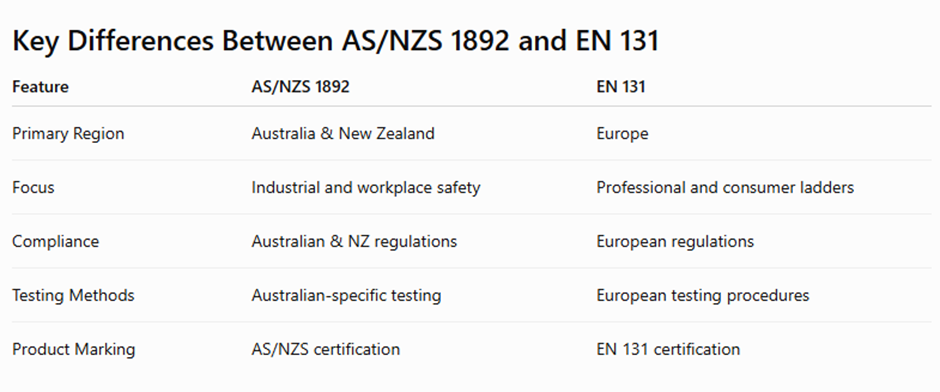
While there are similarities, a ladder certified to one standard is not usually certified to the other.
Does One Standard Make a Ladder Safer?
Not necessarily.
Both standards require rigorous engineering, laboratory testing and quality manufacturing.
The important consideration is whether the ladder complies with the regulations applicable to your workplace.
Rather than asking:
"Which standard is better?"
Safety managers should ask:
"Which standard is required for my workplace, my industry and my country?"
Compliance should always align with local legislation and organisational safety requirements.
What About Multinational Organisations?
Many companies operate across Australia, Europe, Asia and North America.
In these situations, procurement teams often need equipment that complies with multiple regional standards.
This can create challenges when purchasing access equipment internationally.
Working with manufacturers that understand global compliance requirements helps ensure equipment is suitable for the intended market and application.
Beyond Compliance: Engineering Matters
Meeting a safety standard is only one part of the equation.
Factors such as stability, durability, ergonomics and long-term performance also influence workplace safety.
When selecting industrial access equipment, consider:
- Appropriate ladder type for the task
- Surface conditions
- Electrical hazards
- Environmental exposure
- Frequency of use
- Worker training
- Inspection procedures
- Maintenance requirements
A compliant ladder still needs to be the right ladder for the job.
Why Branach Designs for Demanding Work Environments
At Branach, safety is engineered into every product.
Our fibreglass ladders and specialised access equipment are designed for industries where reliability matters most, including utilities, rail, aviation, defence, mining and emergency services.
With over 30 years of innovation in height safety, we understand that compliance is only the starting point. True workplace safety comes from combining robust engineering, high-quality materials and equipment designed for real-world conditions.
Whether your organisation operates locally or globally, selecting the right access solution begins with understanding the standards - and choosing equipment built to meet the demands of your industry.
Frequently Asked Questions
Is EN 131 accepted in Australia?
EN 131 is a recognized European standard. However, organisations operating in Australia or New Zealand should ensure ladders meet the relevant local regulatory and workplace requirements, which commonly reference AS/NZS 1892.
Can a ladder comply with both AS/NZS 1892 and EN 131?
Yes. Some manufacturers design and test products to satisfy multiple international standards. Always verify the certification and documentation for the specific product.
Which standard should I specify for a project?
The applicable standard depends on your project's location, client requirements and local regulations. Consult your organisation's safety policies and procurement specifications before purchasing.
Understanding the differences between AS/NZS 1892 and EN 131 helps safety managers make informed procurement decisions and maintain compliance across different regions.
While the standards differ in their specific requirements, both are designed with the same objective: reducing the risk of falls and creating safer workplaces.
Choosing access equipment that meets the correct standard, suits the application and is supported by proper inspection and training will always be the foundation of effective height safety.
AS/NZS 1892 vs EN 131: What Safety Managers Need to Know Before Choosing a Ladder